
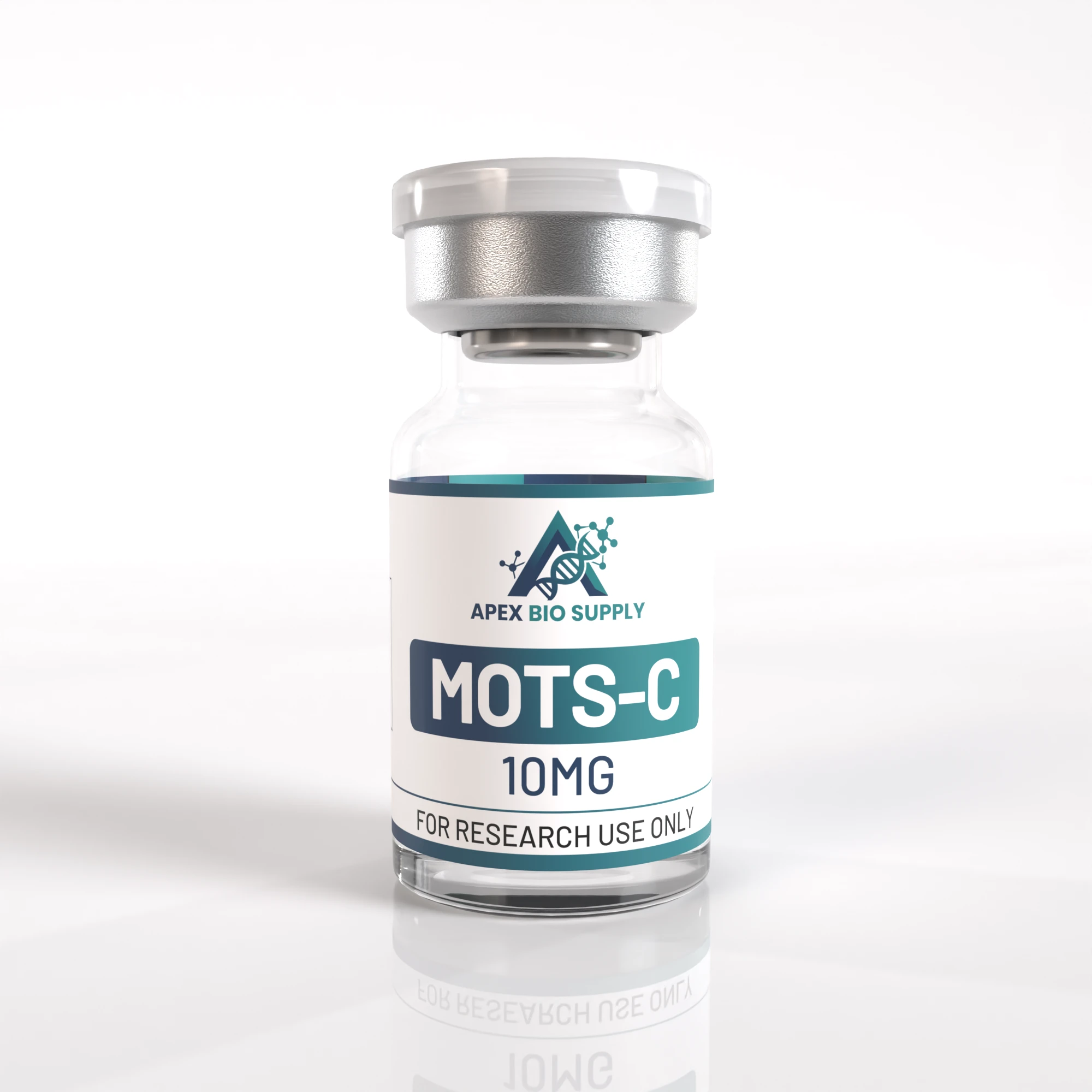

MOTS-C
MOTS-C (Mitochondrial-Encoded Open Reading Frame Small Cysteine-rich protein) is a naturally occurring peptide derived from mitochondrial sequences in animals. Emerging research suggests that MOTS-C holds potential relevance in studies exploring mitochondrial function, metabolic regulation, and aging-related processes, among other areas. This peptide is available for academic and laboratory research purposes only.
MOTS-C has been identified through bioinformatic analysis of mitochondrial open reading frames (MORFs), which have gained attention in recent scientific studies for their potential physiological effects. As a peptide, it shares structural similarities with other bioactive peptides but is specifically encoded within mitochondrial DNA. Its study may provide insights into mechanisms related to energy metabolism, cellular stress responses, and longevity.
Research Overview
Research on MOTS-C is still in its early stages, with key findings primarily derived from in vitro and in vivo studies in model organisms. Early investigations have focused on its expression levels in various tissues and its potential regulatory effects on mitochondrial biogenesis, glucose metabolism, and antioxidant defense mechanisms. While results are preliminary, these studies suggest a potential role in modulating mitochondrial function under physiological and pathological conditions. Further research is required to elucidate its precise biological functions and interactions within complex biological systems.
Key Research Focus Areas
- Mitochondrial Function and Biogenesis: Exploration of MOTS-C’s impact on mitochondrial gene expression, protein synthesis, and the activation of nuclear transcription factors such as PGC-1α (Peroxisome proliferator-activated receptor gamma coactivator 1-alpha), which regulates mitochondrial biogenesis.
- Metabolic Regulation: Investigation of how MOTS-C may influence insulin sensitivity, glucose homeostasis, and energy balance through interactions with metabolic pathways, particularly in the context of aging or disease states.
- Antioxidant and Stress Response Mechanisms: Examination of its potential role in protecting cells from oxidative stress and mitochondrial dysfunction, which are implicated in age-related diseases and metabolic disorders.
- Longevity and Aging: Preliminary studies in model organisms (e.g., worms, flies, and mice) have suggested that MOTS-C may influence lifespan extension or stress resistance, though more rigorous experiments are needed to confirm these findings.
- Comparative Expression Across Species: Analysis of MOTS-C expression levels in different tissues and species, as well as its conservation across evolutionary lines, to understand its evolutionary relevance and potential functional conservation.
It is important to note that the biological effects of MOTS-C are not yet fully characterized, and its precise mechanisms of action remain under investigation. This peptide is intended solely for use in academic and research environments, where it may be employed in cellular, molecular, or biochemical studies.
For research use only. Not for human or animal consumption.
| Size | 10MG, 40MG |
|---|